 Ngorongoro Crater Tour
Home › Guides › What Animals Can You See on a Ngorongoro Crater Safari?
What Animals Can You See on a Ngorongoro Crater Safari?
Giraffes are the one famous animal you will not meet on the crater floor, but almost everything else is there: NCAA counts over 25,000 animals, including the Big Five. This guide to Ngorongoro Crater animals covers which species live inside, where on the floor each one is usually found, the rarest sightings and the myths that trip up first-time visitors on a ngorongoro crater tour.
Quick answer The crater's animals in four lines
The crater holds over 25,000 animals, including lion, leopard, elephant, buffalo and black rhino, plus zebra, wildebeest, hippo, hyena and over 500 recorded bird species. Giraffes are absent because the steep walls block them, and the black rhino, at only about 25-50 animals, is the hardest of the Big Five to find.
Key takeaways
- A full day on the floor gives the most time to search, as on the Ngorongoro Crater Day Trip from Arusha.
- Rhinos and hippos share the Gongor Swamps, a regular stop on a private crater day safari.
- For giraffes and the migration, add other parks on the 3-Day Serengeti and Ngorongoro Group Camping Safari.
- Compare every day trip and multi-day safari on the ngorongoro crater tour homepage.
What animals are in the Ngorongoro Crater?
The crater floor holds the Big Five, large herds of grazers, a dense lion population, hyenas, jackals and over 500 recorded bird species.
Many assume an enclosed crater holds only a few species. NCAA says most NCA species can be found on the crater floor, with the exception of giraffes. The floor covers about 260 square kilometres and is about 20 kilometres across, so the animals are packed into a space you can drive in a day.
Grazers and browsers
Herbivores include blue wildebeest, Burchell's zebra, Thomson's and Grant's gazelles, topi, Coke's hartebeest, Defassa waterbuck and eland. TourRadar says travellers can find at least 50 different species of large mammals and over 200 species of birdlife on a single safari tour.
Predators
The crater has one of the densest lion populations in Africa. Spotted hyenas, cheetahs, leopards, jackals and bat-eared foxes share the floor. SafariBookings adds golden and black-backed jackals and possibly a serval hunting rodents or birds.
Cheetahs are more commonly found in the Lake Ndutu area outside the crater, so do not plan a crater day around one.
Sources: Ngorongoro Conservation Area Authority, Ngorongoro Conservation Area Authority.
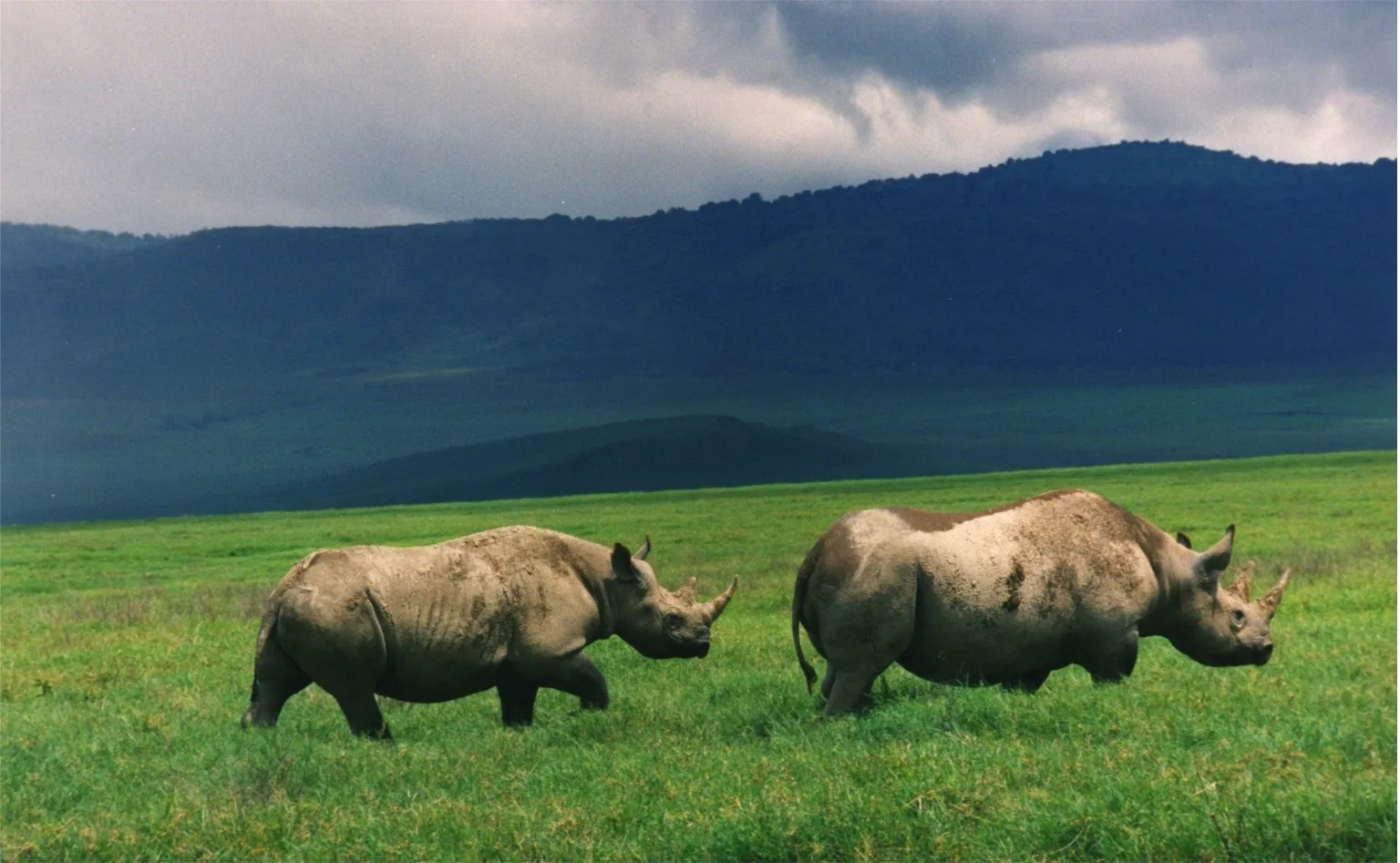
Black rhinos are the rarest animal on the crater floor and are usually seen at a distance. Photo: Brocken Inaglory, CC BY-SA 3.0, via Wikimedia Commons
Can you see the Big Five in one day?
Ngorongoro is considered the only place in the world where you have a great chance of seeing the Big Five all in one day, but no single day guarantees all five.
Many travellers arrive expecting all five as a sure thing. The crater is Tanzania's most productive Big Five destination, yet two of the five depend on luck: the black rhino and the leopard.
Each of the five on the crater floor
Ask your guide which areas they plan to cover before you descend.
| Animal | What the sources say |
|---|---|
| Lion | About 70-75 on the floor in a past count, a newer study predicts closer to 60 |
| Black rhino | Only about 25-50 in Ngorongoro, best spotted in the Gongor Swamps |
| Elephant | Only about 30, herds rarely come through, old bulls with massive tusks are resident |
| Buffalo | One of the Big Five present in the crater |
| Leopard | One of the Big Five present in the crater |
Why time on the floor matters
Crater descent gates close at 16:00. A full-day tour such as the Ngorongoro Crater Day Trip from Arusha at $325 per person runs 10 hours, while the Shared Group Ngorongoro Crater Day Trip at $300 runs 6-8 hours. More hours inside means more passes through the swamps where rhinos feed.
How many rhinos live in the Ngorongoro Crater?
There are only about 25-50 black rhinos in Ngorongoro, best spotted in the Gongor Swamps.
Some visitors think rhinos are as easy to find here as zebras. They are not. NCAA notes that the black rhino is the only species among the NCA's wildlife that the IUCN lists as endangered, and UNESCO lists it as endangered in the NCA too.
How to raise your chances
Rhinos are usually seen at a distance. Vehicles must keep at least 25 metres from animals and off-road driving is not permitted, so binoculars help more than a long lens. A maximum of 5 vehicles may gather at a sighting, which means a queue can form near a rhino.
Ask for a guide who is willing to wait.
Sources: Ngorongoro Conservation Area Authority, UNESCO World Heritage Centre, Ngorongoro Conservation Area Authority.
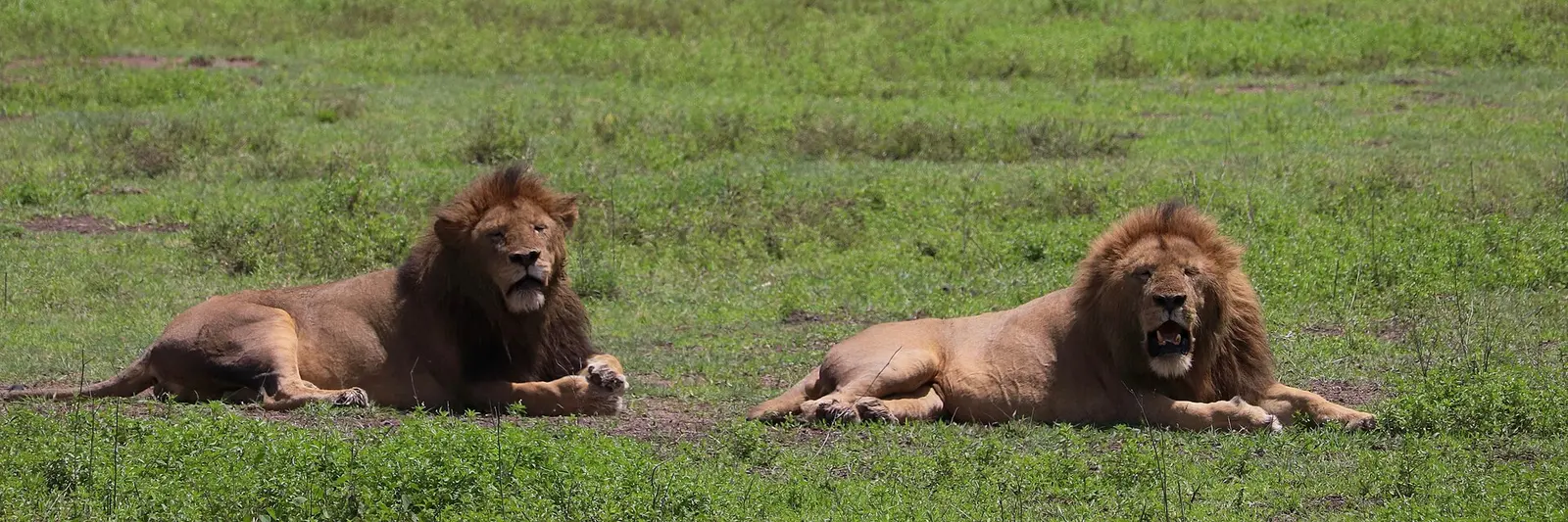
Male lions resting on the crater floor, one of the most reliable big cat sightings in the crater. Photo: James Wagner, CC BY-SA 4.0, via Wikimedia Commons
Tours That Fit
Crater day trips that give a full day on the floor to look for these animals.
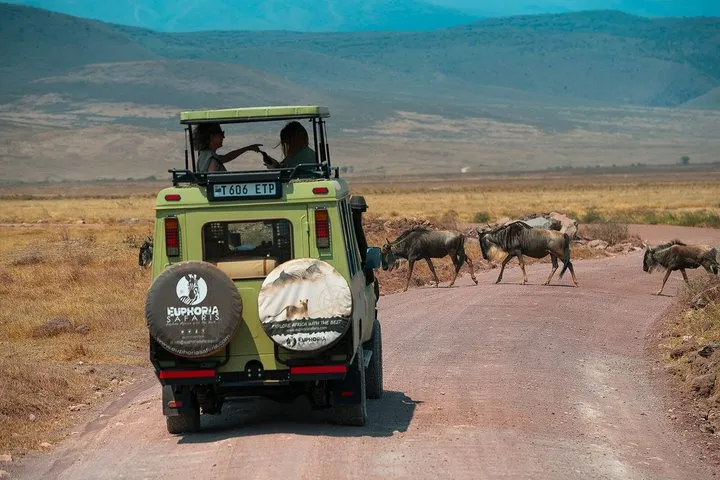 from $325
Most booked day trip
Ngorongoro Crater Day Trip from Arusha
The most-booked crater day trip: a small group of up to 6 from Arusha, with every fee and tax in the price.
Check Availability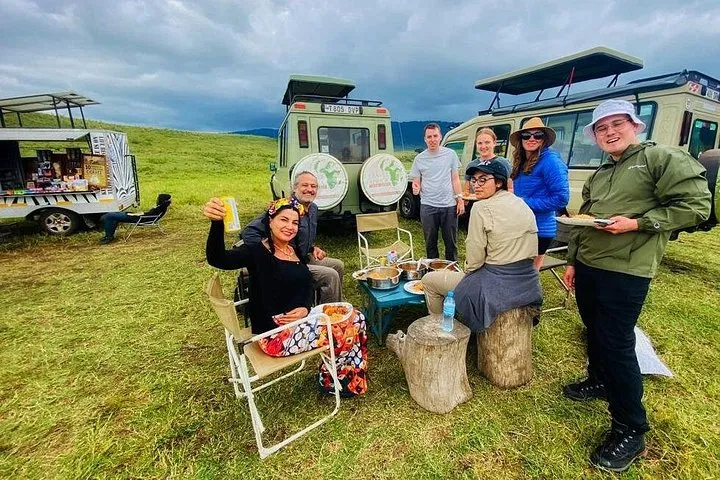 from $350
Private
Private Ngorongoro Crater Day Safari from Arusha
A full day in the crater with breakfast, lunch and drinks, and a guide who speaks English, Spanish or French.
Check Availability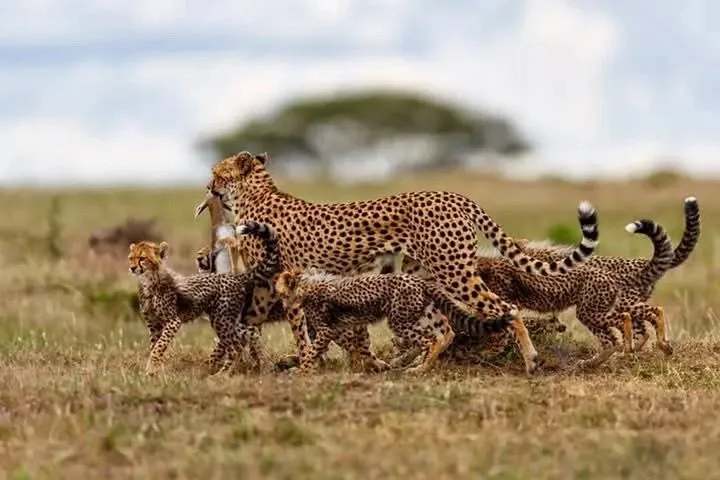 from $380
Crater fees included
Ngorongoro Crater Joining Group Day Trip
A joining-group day from Arusha in a 4x4 with a pop-up roof, crater entry fees in the price.
Check AvailabilityWhy are there no giraffes in Ngorongoro?
The giraffe is absent from the crater floor because the steep walls form a natural barrier it cannot manage.
This is the most common surprise of a crater safari. The giraffe is Tanzania's national animal, but it cannot manage the steep descent into the caldera.
How steep the walls are
The caldera is 610 metres deep, and Micato puts the rim at 2,000 feet above the floor. Giraffes can be spotted in the rest of the conservation area, so you may still see one on the drive in. If a giraffe matters to you, a combined trip such as the 2-Day Tarangire and Ngorongoro Private Camping Safari adds another park to the crater day.
Is the Great Migration inside the crater?
No, the crater is not directly part of the Great Migration's main route.
A widespread myth says the migration herds pour into the caldera. The wildebeest and zebra you see on the crater floor are part of its own wildlife, not the migrating herds.
Where to see the migration instead
UNESCO describes a migration of well over 1 million wildebeest, 72,000 zebras and about 350,000 gazelles. Ndutu is the calving area, with the best time to see the migration from late December to April, per NCAA. To see both, pick a trip that joins the crater with the Serengeti, such as the 3-Day Serengeti and Ngorongoro Group Camping Safari at $770 per person or the 4-Day Tarangire, Serengeti and Ngorongoro Mid-Range Safari at $1,750.
Sources: UNESCO World Heritage Centre, Ngorongoro Conservation Area Authority.
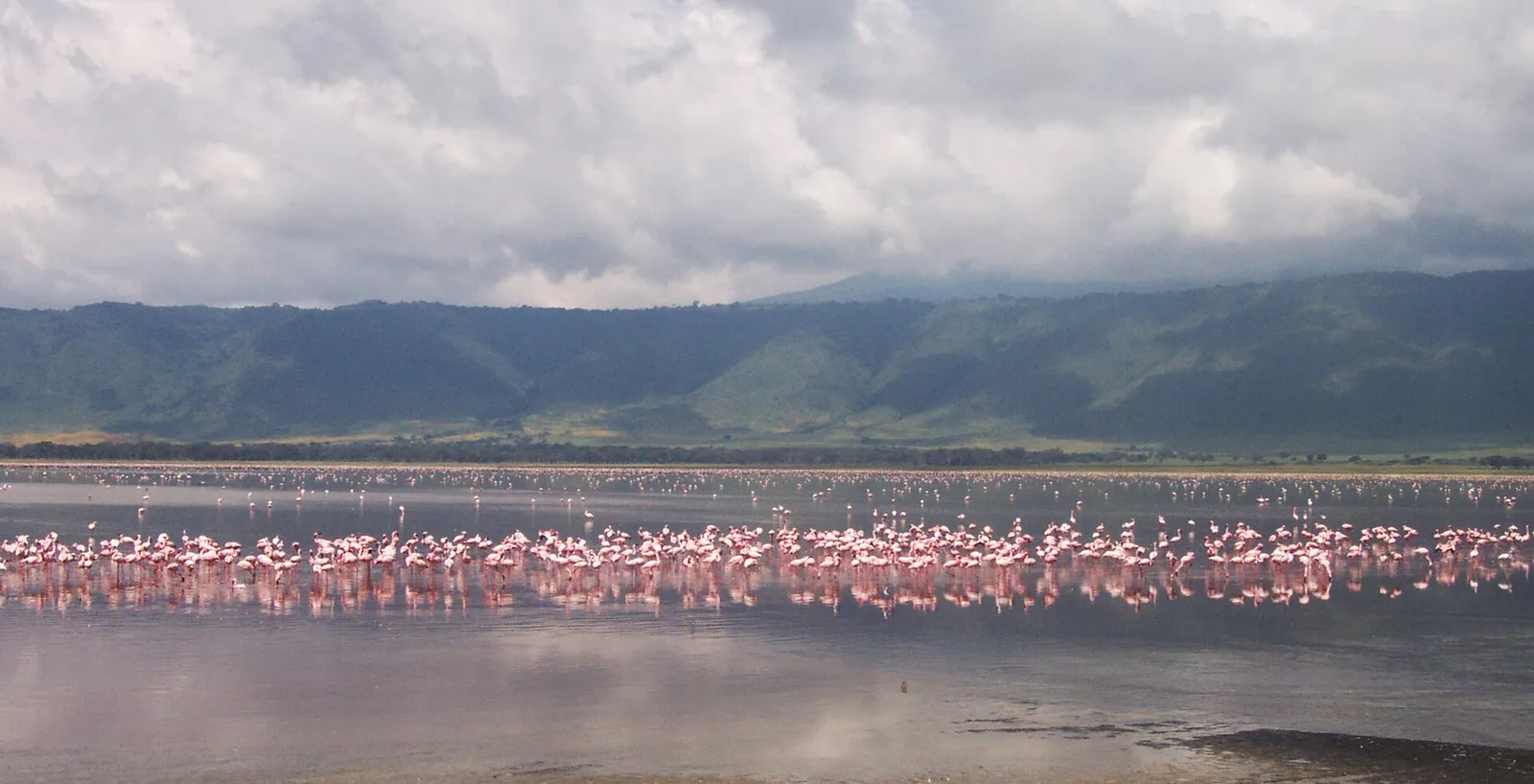
Lesser flamingos feed in the shallow lake on the crater floor when the water suits them. Photo: Remi Jouan, CC BY-SA 3.0, via Wikimedia Commons
Where do hippos gather inside the crater?
Hippos are found around Mandusi Hippo Pool and within the Gongor Swamps.
The crater floor is not one big plain. It is a set of habitats, and each holds different animals.
Habitats of the crater floor
Tanzania Experience lists the Lerai Forest with fever trees, saline Lake Magadi, Gorigor Swamp and the Ngoitokitok Springs hippo pools. TourRadar names Mandusi Hippo Pool and the Gongor Swamps.
| Place | What lives there |
|---|---|
| Gongor Swamps | Black rhino, hippo |
| Mandusi Hippo Pool | Hippo |
| Ngoitokitok Springs | Hippo pools |
| Lake Magadi | Thousands of lesser flamingos |
| Lerai Forest | Fever trees |
| Gorigor Swamp | Swamp habitat on the floor |
Lunch near the animals
There is no ready-food hotel or restaurant inside the crater, only lunch boxes and booked hot-lunch picnic spaces. Designated public picnic areas are free. Except in designated areas, visitors must stay in their vehicles at all times.
Sources: NCAA, Ngorongoro Conservation Area Authority, Ngorongoro Conservation Area Authority.
When is the best time for wildlife viewing?
Wildlife viewing is excellent year round, and it is best in the Dry season from June to October.
Some travellers believe the crater is not worth a visit in the rains. NCAA says the NCA is open all year including the rainy season, and the animals stay on the floor.
Dry and wet seasons
Grass can be long in the Wet season November to May, which hides smaller animals, and March and April are the wettest months. A 4x4 is advised in muddy periods, and only 4x4 vehicles up to 3,500 kg tare weight are allowed on the crater floor anyway. NCAA says temperatures vary from 3°C to 35°C depending on altitude, the rim is colder than the floor, and the coldest months are June to August.
Pack a warm layer.
When to see flamingos
The best time to spot flamingos is from September to April, around Lake Magadi, Lake Ndutu and Empakaai Crater Lake. NCAA describes Lake Magadi as a salt lake often home to thousands of lesser flamingos. Over 500 species of birds have been recorded in the crater, including ostrich, Kori bustard, gray-crowned crane, secretary bird and rosy-throated longclaw.
Sources: Ngorongoro Conservation Area Authority, Ngorongoro Conservation Area Authority, Ngorongoro Conservation Area Authority, NCAA.
What is the rarest animal to see in the Ngorongoro Crater?
The black rhino is the rarest of the crater's well-known animals, and UNESCO also lists the wild hunting dog and golden cat as endangered in the NCA.
Rarity on paper and rarity on a game drive are not the same.
From rare to absent
UNESCO lists black rhino, wild hunting dog and golden cat as endangered species in the NCA. Of the three, only the black rhino has a named crater-floor spot in the sources, the Gongor Swamps. Elephants come next in scarcity, with only about 30 estimated inside Ngorongoro.
Giraffes are not rare in the region at all, they are simply absent from the crater floor. Anyone searching for Ngorongoro Crater wild dogs should know that no source gives a place to look for them on the floor.
Sources: UNESCO World Heritage Centre, Ngorongoro Conservation Area Authority.
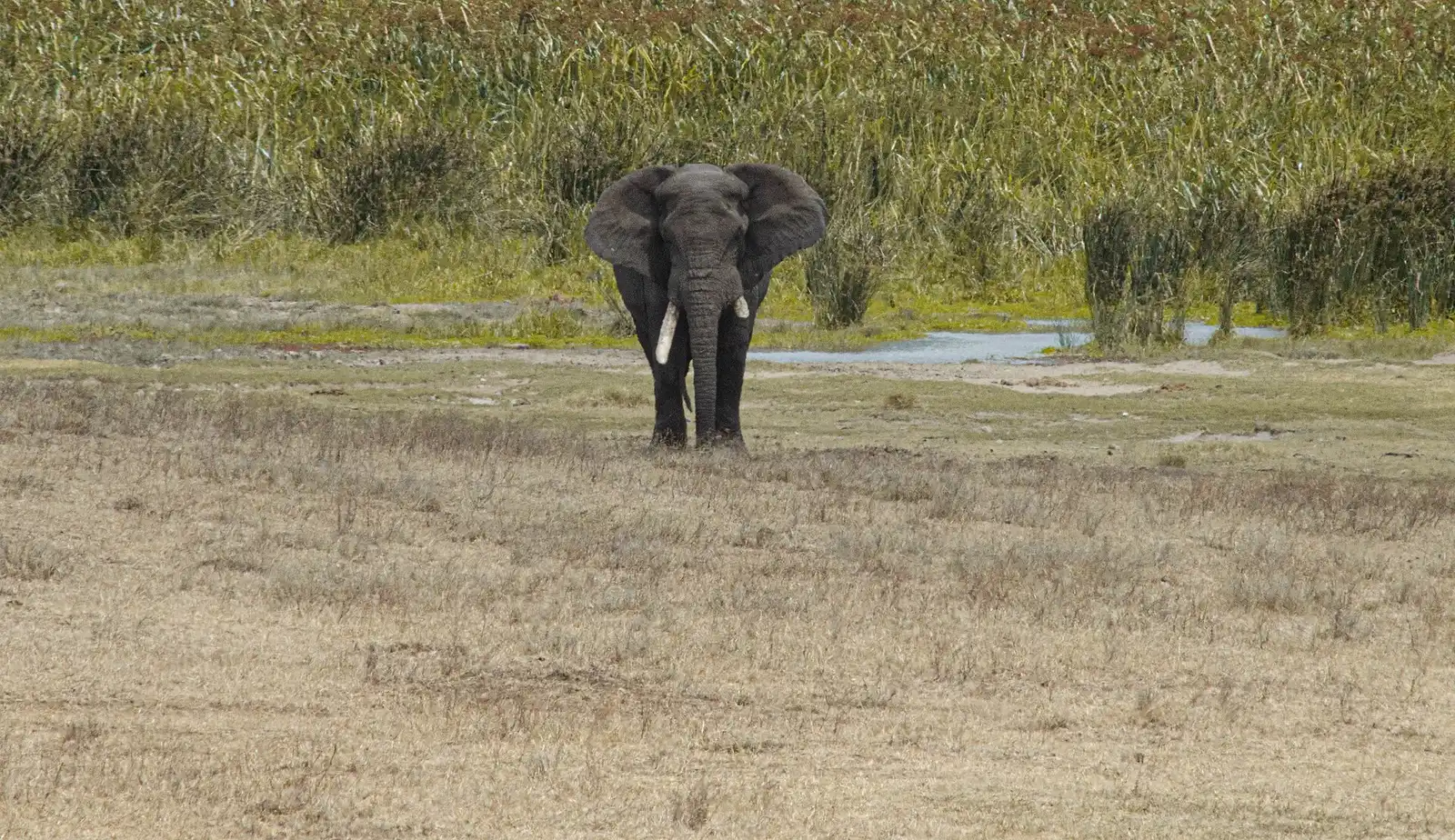
Old bulls are the elephants most often seen on the crater floor. Photo: Erasmus Kamugisha, CC BY-SA 4.0, via Wikimedia Commons
Can you walk among the animals in the crater?
No, walking safaris are not allowed inside the Ngorongoro Crater, though they are allowed on the rim and in other areas of the NCA.
A walking safari sounds like the closest way to meet the animals, but on the floor the vehicle is your hide.
Rules that shape your game drive
A licensed guide or an official NCAA guide must accompany all crater visitors. Any authorised walking safari in the NCA must be accompanied by an armed NCAA ranger. The speed limit is 25 km/h at the craters.
Domestic pets are forbidden in the NCA, so a dog friendly Ngorongoro Crater visit is not possible. The crater service fee for non-East African citizens is USD 295 ($295) per vehicle per trip, per the NCAA tariff page, and the NCA entry permit for non-East African adults is USD 70.80 ($70.80).
Sources: Ngorongoro Conservation Area Authority, Ngorongoro Conservation Area Authority, Ngorongoro Conservation Area Authority.
Ngorongoro Crater Animals FAQ
How many lions are on the crater floor?
There were about 70-75 lions on the crater floor in a past count, and a more recent study predicts closer to 60, per TourRadar. A full day on the floor, as on the Private Ngorongoro Crater Day Safari from Arusha at $350 per person, gives the most time to find them.
Can I bring my dog to the Ngorongoro Crater?
No. Domestic pets are forbidden in the NCA under the NCAA visitor guidelines. Plan care for your dog before you book a ngorongoro crater tour.
Are there wild dogs in the Ngorongoro Crater?
UNESCO lists the wild hunting dog as an endangered species in the NCA, but no source names a crater-floor spot for them. The Ngorongoro Crater Joining Group Day Trip focuses on the floor's resident animals.
What does the cheapest crater day trip cost?
The Budget Ngorongoro Crater Day Trip from Moshi or Arusha costs $115 per person with about 6 hours in the crater, plus mandatory extras of $169 per person paid in cash the day before for the entrance fee, crater service fee and 18% VAT.
Do I need a multi-day safari to see more animals?
A crater day covers the floor, and giraffes and the migration need other areas. The 5-Day Serengeti and Ngorongoro Private Safari at $2,845 per person adds the Serengeti.
More Guides
- 2-Day Tanzania Safari to Tarangire and the Ngorongoro Crater
2-day safaris from Arusha with 1 night out, compared on crater fees and where you sleep in 2027. Pick the one that fits.
- 3-Day Tanzania Safari With the Ngorongoro Crater
3-day Tanzania safari routes for 2027: 2 nights, the crater plus Serengeti or Tarangire and Manyara. Compare what each trip covers.
- 5-Day Tanzania Safari: Tarangire, Serengeti and the Ngorongoro Crater
5-day Tanzania safari routes for 2027: 4 nights, Tarangire, Serengeti and the crater. See what each trip includes and pick yours.